

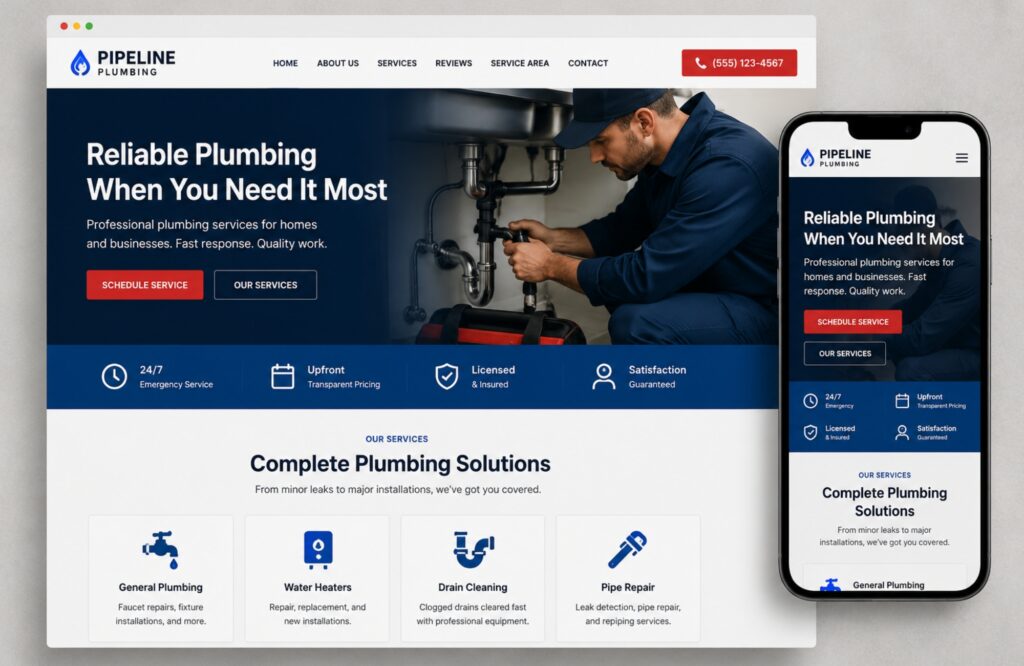
Web design for plumbers is not about making a site look good. It is about building a professional website that gets the phone ringing. A well-built plumbing website puts your number in front of the right person at the right moment, removes every reason they might hesitate, and makes it as easy as possible for them to contact you.
In this article, you will learn the nine essential elements that separate a successful plumbing website from one that sits online and does nothing. Each feature connects directly to more service calls, more new clients, and stronger visibility in local search results.
Why Does Web Design for Plumbers Need to Be Different?
Plumbing is one of the few service industries where potential customers are often in a stressful situation when they search. A burst pipe, a blocked drain, a water heater that stopped working at 7 PM on a Friday. The person searching is not browsing casually. They want a plumber fast, and they will call the first business that looks trustworthy and makes contact easy.
According to Plumbing SEO Agency’s 2026 statistics, 46% of all Google searches carry local intent, and plumbing is one of the most locally-driven service categories in that pool. Add to that the finding from Amra and Elma’s 2026 plumbing marketing report that 60% of mobile users contact a local business directly from search results using click-to-call, and the message is clear. Your website needs to be built for speed, trust, and immediate action.
Many plumbing businesses still rely on word-of-mouth, newspaper ads, and social media platforms to find new clients. Social media marketing and referrals have their place, but they cannot replace what a well-designed website delivers: 24/7 visibility in search results, the ability to reach potential customers who have never heard of your business, and a professional digital presence that turns organic traffic into booked jobs. A single plumbing company with a properly built site will consistently outperform competitors with stronger reputations but weaker websites.
Feature 1: Is Your Phone Number Visible Before Anyone Has to Scroll?
The single most important element on a plumbing website is a phone number that is impossible to miss. It should sit in the top right corner of every page, in a large font, as a clickable link on mobile devices.
This is called a click-to-call button. When someone on a smartphone taps it, their phone dials your number automatically. According to Amra and Elma’s 2026 plumbing marketing report, 60% of mobile users contact a local business directly from search results using click-to-call. If your number is buried at the bottom of a page or only appears on the Contact page, you are losing those calls.
There are two types of plumbing customers. The first is dealing with an emergency and needs a number right now. The second is comparing options, and you will spend a little more time on your site before deciding. Both need to see your number immediately. Put it in the header, make it tappable, and include it again mid-page on longer service pages. A sticky header that stays visible as someone scrolls is one of the most effective ways to keep that number accessible and generate more service calls from website visitors.
Feature 2: Does Your Homepage Answer the Right Questions in the First Five Seconds?
Your homepage hero section needs to answer three questions immediately: What do you do? Where do you do it? How do they reach you?
A strong opening for a plumbing business looks something like this:
Emergency Plumber in [City]. Available 24/7. Call Now.
That tells someone everything they need in under ten words. From there, add a subheading with more detail, high-quality images of your team or truck, and a prominent call-to-action button.
The hero section should also include one or two trust indicators above the fold: licensed and insured, years in operation, or a star rating with the number of business reviews. According to Plumbing Webmasters, including license numbers, real photos of your team, and customer ratings directly on the homepage measurably improves conversion rates. An easy-to-navigate homepage is one of the most reliable ways to reduce bounce rates and get more customers to take action.
Feature 3: How Do Separate Service Pages Help a Plumbing Business Rank?
One of the most common mistakes in plumbing website design is listing every service on a single page. Drain cleaning, water heater repair, pipe replacement, and emergency plumbing all crammed into one block of text hurts both your Google rankings and your ability to convert website visitors.
Each service should have its own dedicated page with clear service descriptions. When someone searches for “water heater repair in [city],” Google looks for a page specifically about that service. Dedicated service pages with strong service descriptions rank more effectively for specific search queries and deliver plumbing services online more credibly to users who are ready to book.
A well-structured plumbing website should have individual pages for at least:
- Emergency plumbing
- Drain cleaning and sewer services
- Water heater installation and repair
- Pipe repair and repiping
- Leak detection
- Specialty services (gas lines, water filtration, commercial plumbing)
Each page should describe the service, include your service area, and end with a visible phone number or contact form. This structure is the foundation of effective search engine optimization for plumbing companies that want to rank across multiple service categories.
Feature 4: What Does Page Speed Mean for a Plumbing Website?
Page speed is a direct line to revenue. A slow website costs you jobs. If your site takes more than three seconds to load on mobile devices, a large portion of visitors will leave before they ever see your phone number.
Research from Mewa Studio’s Core Web Vitals Guide 2026 found that pages loading in under two seconds have a 9% bounce rate, while pages taking more than five seconds see that jump to 38%. Google measures website performance through three Core Web Vitals metrics, confirmed ranking signals since 2021:
| Metric | What It Measures | Good Score |
| LCP (Largest Contentful Paint) | How fast the main content loads | Under 2.5 seconds |
| INP (Interaction to Next Paint) | How fast the page responds to taps | Under 200ms |
| CLS (Cumulative Layout Shift) | Whether page elements jump while loading | Under 0.1 |
As of 2026, only 47% of websites globally pass all three thresholds. Plumber websites built on bloated templates or low-quality hosting are frequent offenders. A WordPress site built by professional web designers and web developers on quality hosting will typically clear all three without difficulty. A template pulled from a basic website builder will usually struggle.
Feature 5: Why Is Mobile Optimization Non-Negotiable?
More than half of all web traffic comes from mobile devices. For plumbing specifically, that number skews higher because of emergency search behavior. A 2025 Invoca study found that 56.1% of home service seekers search from mobile, and Amra and Elma’s 2026 plumbing marketing report found that 70% of mobile users click on the local Map Pack when searching for local services.
A mobile-responsive plumbing website is not a smaller version of the desktop site. It needs to be purpose-built for how people use phones:
- Large text, readable without zooming
- Buttons big enough to tap comfortably
- Contact forms with large input fields and minimal required fields
- Navigation that collapses into a clean menu
- Phone number as a tappable click-to-call link, not plain text
Despite this, a 2025 report from Google Webmasters found that 59% of plumbing websites are still not properly mobile-optimized. That is a real opportunity. Any plumber with a well-built, mobile-responsive site has a clear advantage over the majority of competitors in their local area.
Feature 6: How Do Reviews and Trust Signals Affect Plumbing Inquiries?
A plumber coming to your home is a significant act of trust. Your digital presence needs to build that trust before someone picks up the phone. The most effective trust signals for a successful plumbing website are:
- Online reviews and star ratings. Embed your Google Business Profile review feed or display your rating and customer testimonials prominently. Loopex Digital’s 2025 research found that the impact of online reviews on purchase decisions has never been stronger for service businesses.
- License and insurance information. Display your license number. It is one of the most underused trust signals in the plumbing industry, and it removes a common objection before it is raised.
- High-quality images. Real high-quality images of your team, truck, and completed plumbing work outperform stock photos. According to a 2026 analysis by Simpro, real photos help visitors connect with the people behind the service.
- Guarantees and response times. If you offer same-day service or a satisfaction guarantee, say so clearly next to your call-to-action buttons.
Feature 7: What Role Does Local SEO Play in a Plumbing Website?
Local SEO is not a separate strategy. It is built into your site’s structure, and it is how your plumbing business shows up when someone in your local area searches for the services you offer.
Plumbing SEO Agency’s 2026 statistics show that 55% of plumbing leads come from Google Maps listings, and only 26% of plumbing companies actively invest in SEO optimization. That low adoption rate means any plumber with a properly optimized site can outrank the majority of local businesses in their service area.
Here is what local SEO looks like in practice:
- Google Business Profile is connected to your website. Your Google Business Profile drives your appearance in the local Map Pack. Your GBP listing and your website work together. Business name, address, phone number, and service area need to be consistent across both.
- Location pages for each service area. If you serve multiple cities, each should have its own page. A page titled “Plumber in [City]” with content specific to that area will rank for searches in that location.
- SEO optimized content on every page. Your city and service area should appear naturally in page titles, headings, and body content. This is what web designers mean when they say a site is built for search engine optimization.
- Schema markup. This is structured code invisible to website visitors that tells Google your service area, business hours, and review ratings. It helps search engines display rich results like star ratings directly in search results.
Feature 8: Does Your Website Have a Contact Form That Works?
Not every plumbing inquiry comes as a phone call. Some potential customers prefer to send a message, especially for non-emergency plumbing work or when researching outside business hours. A contact form captures those leads.
A high-converting contact form for a plumbing website should:
- Ask only for the essentials: name, phone number, service needed, and a brief description
- Be easy to complete on mobile devices with large input fields
- Include a clear submit button (“Send My Request” or “Get a Quote”)
- Send an automated confirmation immediately after submission
- Notify you by email or SMS the moment a form is submitted
Place the form on every service page, not just the Contact page. Some plumbing businesses also add chat tools to capture leads from website visitors who are still in the comparison stage and prefer to ask a quick question before committing to a call.
Feature 9: How Does Website Maintenance Affect Ongoing Lead Generation?
A new website is not a one-time project. It is a business asset that needs ongoing attention. A site that ranked well at launch can drop in search positions within 12 to 18 months without regular upkeep.
Ongoing SEO and website maintenance include:
- Software and security updates. WordPress sites require regular plugin and theme updates. Outdated software creates security vulnerabilities that can get your site blacklisted by Google, which removes it from search results entirely.
- Website performance monitoring. Core Web Vitals scores degrade over time as plugins are added or hosting performance changes. Regular monitoring through Google Search Console catches issues before they affect rankings.
- SEO optimized content updates. Google favors websites with regularly updated content. Adding new service pages and updating existing ones with current information contributes to stronger ongoing search visibility. Content writing is one of the most cost-effective digital marketing services a plumbing business can invest in after the initial build.
- Online review integration. Keep your customer testimonials and review counts current. Stale business reviews weaken the trust your site builds with new visitors.
According to WebFX’s 2026 home services marketing benchmarks, plumbing leads convert at 12 to 16%, the highest rate in the entire home services industry. A well-maintained site with a strong digital marketing foundation holds onto that conversion potential month after month.
What Does a Plumber Web Design Agency Do for Your Business?
Hiring a plumber web design agency is different from hiring a general design company or using a website builder. A specialist in plumbing web design understands the conversion requirements, local SEO structure, and content needs specific to the plumbing industry. They have built plumber websites for a clearly defined target audience, so they know how homeowners behave when they land on a plumbing site under pressure.
WebHaus plumber web design services include the full build of custom websites on WordPress, on-page search engine optimization, Google Business Profile setup, mobile responsive design, and an ongoing website maintenance plan. Website design services for professional plumbing businesses also cover local SEO structure, content writing, and conversion-focused page layouts. Plumbers who own their own websites outright, rather than renting access to a platform, are in a much stronger long-term position when it comes to building organic traffic and protecting their digital presence.
Here is what to look for when evaluating any web design company:
| What to Check | Why It Matters |
| Portfolio of plumber websites | Shows real experience with this service category |
| Custom websites vs. templates | Custom websites perform better in search and convert at higher rates |
| Ownership transparency | You should own your website and its content outright |
| Ongoing SEO services included | A new website without ongoing SEO will plateau quickly |
| Clear reporting | You need to see what your site is doing for your business |
The difference between a great website built by web designers who understand the plumbing industry and a generic template from a website builder shows up in your search rankings, your client retention rate, and the number of new clients your site brings in each month. Some plumbing businesses also work with project managers and digital marketers at digital marketing agencies who coordinate web design, SEO services, content writing, and social media platforms together as a unified strategy. Whether you go that route or start with the website alone, the site is always the foundation.
What Makes a Plumbing Website Actually Work?
A successful plumbing website does not need to be complicated, but it does need to be intentional. Every feature should serve the same goal: get more qualified visitors to contact your business.
| Feature | Business Outcome |
| Click-to-call phone number | More service calls from mobile visitors |
| Clear homepage hero section | Faster decisions, lower bounce rate |
| Individual service pages with service descriptions | Higher rankings, better-matched organic traffic |
| Fast page speed and website performance | Better Google rankings, lower bounce rate |
| Mobile responsive design | Captures emergency searches on mobile devices |
| Online reviews and customer testimonials | More website visitors convert into callers |
| Local SEO, seo optimization, and Google Business Profile | Appears in local Map Pack results |
| Contact form and chat tools on every page | Captures non-emergency plumbing inquiries |
| Ongoing SEO and website maintenance | Sustains lead generation over time |
A plumber without a strong digital presence relies entirely on word-of-mouth and paid ads to grow. Both have limits. A well-designed website built by experienced web developers keeps working around the clock, capturing organic traffic, building trust, and converting website visitors into more customers.
Conclusion
A plumbing website built with these nine features will consistently outperform a basic or template-built site in search visibility, visitor trust, and lead conversion. The goal is not to have the most impressive site in the plumbing industry. The goal is to have one that brings in more customers and gets the phone ringing.
At WebHaus, we build custom websites for plumbing businesses that are fast, mobile responsive, locally optimized, and designed to convert website visitors into real inquiries. We handle everything from the initial build to ongoing website maintenance, so your site keeps performing long after it launches. Get started today and contact our team for a free website consultation.
FAQs
What should a plumber’s website include?
A plumbing website should include a visible phone number with click-to-call functionality, a clear homepage that states the service and local area, individual service pages with strong service descriptions, customer testimonials and online reviews, license information, and a contact form. Mobile optimization and fast page load speed are also required. Each of these essential elements works together to help potential customers quickly confirm they are in the right place and take action.
How much does it cost to design a plumbing website?
Plumbing website design typically costs between $3,000 and $10,000 for custom websites professionally built by web designers, depending on the number of service pages and features. Template-based DIY sites built on a website builder can be done for $500 to $1,500 but often lack the customization, website performance, and SEO structure needed to compete in local search results. Ongoing costs for website maintenance and SEO services typically range from $100 to $500 per month.
How do I get more leads from my plumber website?
Getting more leads from a plumbing website comes down to three things: visibility, trust, and friction reduction. Visibility means your site ranks in local search results and appears in the Map Pack. Trust means potential customers quickly see evidence that you are licensed, reviewed, and reliable. Friction reduction means making it as fast and simple as possible to call you or submit a form.
Does a plumber need a website?
Yes. According to Plumbing SEO Agency’s 2026 data, 55% of plumbing leads come from Google Maps listings, and Google uses your website as a primary signal when deciding whether to show your plumbing business in local results. Research also shows that 90% of consumers search online for a business after hearing about it by word-of-mouth. Without a website, you lose the leads you already earned through referrals.

Thomas Guardado is a seasoned digital marketing expert with over a decade of experience helping businesses grow their online presence and generate leads. He specializes in search engine optimization (SEO), paid advertising, and conversion-focused website strategies, combining data-driven insights with proven marketing techniques.
Throughout his career, Thomas has worked with a wide range of businesses, developing and executing strategies that improve visibility, increase traffic, and drive measurable results. Known for his practical approach and deep understanding of digital trends, he focuses on building sustainable growth for the brands he supports.