

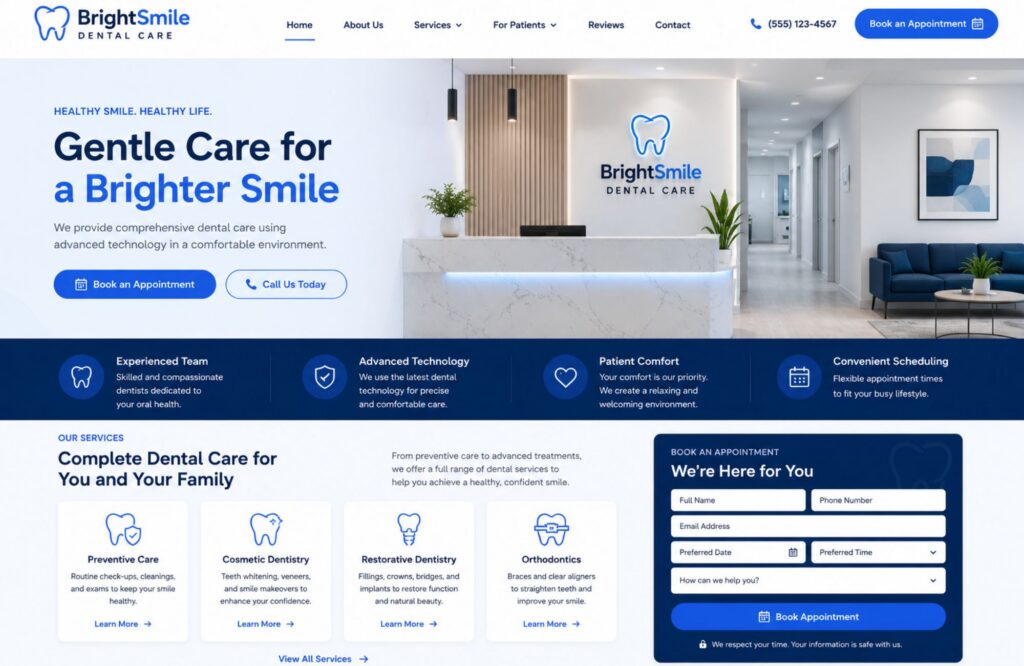
Web design for dentists is about more than creating a professional-looking website. A dental website should help patients find your practice, build trust in your expertise, book appointments easily, and protect sensitive information. The best dental practice websites combine strong user experience, local SEO, patient-focused content, and healthcare privacy considerations to support practice growth.
In this guide, you’ll learn what makes effective web design for dentists, how online booking affects patient acquisition, why EEAT matters for dental websites, what HIPAA means for forms and patient communications, and how to build a website that supports both visibility and new patient appointments.
What Makes Web Design for Dentists Effective?
Effective web design for dentists helps prospective patients answer three questions quickly: Can this practice help me? Can I trust them? How do I book an appointment? If visitors cannot find those answers within seconds, many leave the site and continue their search elsewhere.
A dental website often serves as a patient’s first impression of a practice. According to the American Dental Association, many patients research providers online before scheduling care. Your website becomes a marketing tool, trust signal, and appointment channel at the same time.
The strongest dental website design projects focus on usability before aesthetics. A clean layout, mobile-friendly navigation, and visible appointment options typically matter more than bold colors or complex visual effects.
Key elements of great dental websites include:
| Element | Business Benefit |
| Mobile-friendly design | Makes it easier for patients to contact the practice from any device |
| Online scheduling | Reduces booking friction and increases appointment requests |
| Service pages | Helps patients understand treatments and options |
| Dentist biographies | Builds trust and demonstrates expertise |
| Patient testimonials | Supports credibility and social proof |
| Local SEO optimization | Improves visibility in local search results |
| Fast page speed | Keeps visitors engaged |
| Secure forms | Protects patient information |
Google’s Search Quality Rater Guidelines place a strong focus on experience, expertise, authoritativeness, and trustworthiness for health-related content. Healthcare websites fall under what Google calls “Your Money or Your Life” content, where accuracy and trust play a larger role in search visibility.
For dentists, this means your website should clearly show:
- Professional credentials
- Licenses and certifications
- Real office information
- Treatment experience
- Staff biographies
- Contact details
- Patient-focused educational content
These trust signals support both rankings and patient confidence.
Why Do Online Booking and Scheduling Matter So Much?
Online booking has become one of the most valuable features in web design for dentists because patients increasingly expect to schedule appointments on their own time. Many people search for healthcare providers outside normal business hours, and a phone-only booking process can create unnecessary friction.
Research from Accenture’s Digital Health Consumer Survey found that patients continue to prefer digital healthcare interactions when convenient scheduling options are available. While dental practices differ from medical practices, patient expectations around convenience have shifted across healthcare.
A common scenario illustrates the issue:
Practice A has:
- Phone number only
- Contact form response within 24 hours
- No scheduling visibility
Practice B has:
- Mobile-friendly booking option
- Clear appointment availability
- Immediate confirmation process
Patients who are ready to schedule often choose the path requiring the fewest steps.
Good online scheduling systems should:
- Work well on mobile devices
- Display available appointment options clearly
- Provide confirmation messages
- Connect with practice workflows
- Minimize unnecessary form fields
At the same time, dentists should evaluate privacy implications before adding scheduling tools. Some appointment systems collect patient information, which may affect compliance obligations depending on how data is stored, transmitted, and managed.
One mistake dental practices make is placing appointment buttons where visitors struggle to find them. Another is requiring users to complete lengthy forms before seeing scheduling options. Shorter paths often produce better conversion rates because patients can take action without frustration.
The goal is simple: help patients move from interest to appointment as smoothly as possible. When a dental website removes obstacles from the booking process, it often becomes a stronger driver of new patient acquisition and practice growth.
Why EEAT Matters for Dental Websites
EEAT helps Google and potential patients determine whether a dental website can be trusted. For healthcare topics, trust carries more weight because patients rely on website content when making decisions about treatment, providers, and appointments. A dental website that demonstrates real expertise and transparency is more likely to build credibility with both users and search engines.
EEAT stands for:
- Experience
- Expertise
- Authoritativeness
- Trustworthiness
Google highlights these factors throughout its Search Quality Evaluator Guidelines, especially for healthcare and medical content. Dental websites fall into the category of content that can influence a person’s health decisions. As a result, visitors and search engines expect a higher standard of accuracy and transparency.
Many dental practice websites focus heavily on appearance while giving very little information about the professionals behind the practice. This can create uncertainty for prospective patients.
Strong EEAT signals for dentists include:
| EEAT Signal | Example |
| Dentist biographies | Education, certifications, and clinical experience |
| Real office photos | Images of the actual practice and team |
| Treatment information | Accurate explanations of procedures |
| Author information | Content reviewed by qualified dental professionals |
| Patient testimonials | Authentic feedback from patients |
| Contact details | Physical address, phone number, and office hours |
| Professional affiliations | ADA memberships and industry organizations |
For example, a page about dental implants should explain the treatment, discuss candidacy factors, answer common questions, and identify the provider responsible for the information.
Patients often look for answers to questions such as:
- How long does treatment take?
- What does recovery involve?
- Am I a good candidate?
- What experience does the dentist have?
Content that addresses these questions directly can support both patient trust and search visibility.
An often-overlooked EEAT factor is keeping information current. Office hours, team members, accepted insurance plans, services, and provider credentials should be reviewed regularly. Outdated information can damage trust even when the website design looks modern.
The goal is not simply to rank higher. The goal is to give dental patients confidence that they are working with qualified professionals who provide accurate and trustworthy information.
What HIPAA Means for Dental Website Forms and Patient Data
HIPAA affects how dental practices handle protected health information. While not every dental website automatically falls under HIPAA requirements, practices must pay close attention to forms, appointment requests, patient communications, and any system that collects or stores health-related information.
The U.S. Department of Health and Human Services defines protected health information (PHI) as individually identifiable health information maintained or transmitted in any form.
A common mistake occurs when practices add website forms without evaluating what information patients can submit.
Consider two examples:
Lower-risk contact form
- Name
- Phone number
- General inquiry
Higher-risk patient form
- Medical conditions
- Treatment history
- Insurance information
- Symptoms
- Patient records
The second example may involve PHI and requires greater attention to privacy, security, and vendor compliance.
Dental practices should review:
- Appointment request forms
- Patient intake forms
- Live chat systems
- Patient portals
- Online scheduling platforms
- Form plugins
- Email workflows
The HIPAA Security Rule requires covered entities and business associates to implement safeguards that help protect electronic protected health information (ePHI). For many dental websites, this leads to questions about hosting providers, form software, appointment systems, and business associate agreements (BAAs). A practical approach is to involve both your website provider and compliance advisor before launching any feature that collects patient information.
Key website privacy considerations include:
| Website Feature | Privacy Consideration |
| Contact forms | Information collected |
| Appointment requests | Data transmission and storage |
| Live chat | Patient information disclosure |
| Patient portals | Authentication and access controls |
| Analytics tools | Visitor data collection |
| Third-party integrations | Vendor responsibilities |
HIPAA compliance is not a website plugin or checkbox. It involves technology, policies, staff procedures, and vendor relationships working together.
For dental practices, the safest approach is to evaluate privacy requirements during the website planning process rather than after the site launches. This can reduce risk, prevent expensive revisions, and help maintain patient trust.
What Features Should Every Dental Website Include?
The best web design for dentists combines trust-building content, easy appointment scheduling, strong local SEO, and a user-friendly experience. Every page should help visitors understand your services, trust your team, and take the next step toward becoming a patient.
Many dental practice websites become cluttered over time. New services, promotions, and content are added without a clear structure. The result is a site that confuses visitors instead of helping them.
A high-performing dental website should include:
Trust Features
- Dentist and team biographies
- Professional credentials
- Office photos
- Patient testimonials
- Before-and-after galleries where appropriate
- Accepted insurance information
- Financing options
Conversion Features
- Online scheduling
- Click-to-call phone numbers
- Appointment request forms
- Emergency contact information
- Clear calls to action
- Location maps and directions
SEO Features
- Service pages for each treatment
- Location pages when serving multiple communities
- Local SEO optimization
- Schema markup
- Optimized title tags and meta descriptions
- Fast-loading pages
- Mobile-friendly design
Technical Features
- Secure hosting
- SSL certificate
- Image optimization
- Accessibility considerations
- Backup systems
- Software updates
The table below shows how these features support practice growth.
| Website Feature | Business Outcome |
| Online scheduling | More appointment requests |
| Mobile-friendly design | Better user experience |
| Service pages | Higher search visibility |
| Testimonials | Increased patient trust |
| Local SEO | More local patients |
| Fast page speed | Lower abandonment rates |
| Secure forms | Stronger patient confidence |
According to Google Page Experience Documentation, page experience signals help Google understand how users interact with a website. While content quality remains the primary factor, usability still plays a role in overall performance.
A common mistake is treating the website as an online brochure. The strongest dental websites function as active business tools that support visibility, patient acquisition, and appointment generation.
How Local SEO Helps Dentists Get More Patients
Local SEO helps dental practices appear when patients search for services in a specific geographic area. Searches such as “dentist near me,” “emergency dentist,” or “Invisalign dentist in Chicago” often indicate a strong intent to book an appointment.
Google reports that local search remains one of the primary ways consumers discover nearby businesses.
For dentists, local SEO often involves:
- Google Business Profile optimization
- Consistent business information
- Local service pages
- Patient reviews
- Location-specific content
- Local citations
- Structured data markup
Patients search differently depending on their needs.
| Search Query | Search Intent |
| Dentist near me | Immediate provider search |
| Emergency dentist | Urgent care |
| Teeth whitening | Service research |
| Pediatric dentist | Specialized treatment |
| Dental implants | Treatment evaluation |
A strong local SEO strategy helps dental websites appear in:
- Local pack results
- Google Maps
- Organic search results
- Voice searches
- AI-generated search experiences
Reviews also influence trust and visibility.
Research published by BrightLocal Local Consumer Review Survey consistently shows that consumers use reviews when evaluating local businesses. For dental practices, reviews help prospective patients answer a simple question: “Can I trust this provider?”
Local SEO works best when paired with strong web design. Traffic alone does not generate appointments. Visitors must also find the information they need and feel confident enough to schedule care.
What Real-World Lessons Can Dentists Learn From Successful Healthcare Websites?
Successful healthcare websites often improve results through small usability improvements rather than dramatic redesigns. The most effective changes usually remove friction from the patient journey.
Google’s own research on mobile user behavior found that users prefer websites that help them complete tasks quickly and easily.
Several patterns appear consistently across high-performing healthcare websites:
Patients Prefer Simplicity
Visitors often spend only a short time deciding whether to stay on a website.
Practices that present:
- Clear navigation
- Obvious scheduling options
- Simple service explanations
- Visible contact information
often create a stronger first impression than websites filled with animations and visual effects.
Real Photos Build More Trust
Healthcare consumers frequently look for signs that a practice is legitimate and welcoming.
Real photos of:
- Dentists
- Hygienists
- Staff members
- Treatment rooms
- Office spaces
help establish credibility and professionalism.
Mobile Experience Directly Affects Appointments
According to Google’s mobile usability guidance, users are more likely to abandon websites that are difficult to use on smartphones. For many dental practices, most new patient traffic now arrives from mobile devices.
The Most Expensive Mistake
One of the costliest mistakes occurs when practices invest heavily in visual design but neglect booking workflows.
A beautiful website cannot generate appointments if:
- Scheduling is difficult
- Contact forms fail
- Phone numbers are hard to find
- Pages load slowly
- Service information is incomplete
The strongest dental websites balance appearance, usability, SEO, privacy, and patient trust.
Conclusion
Web design for dentists should help patients find your practice, trust your expertise, and schedule appointments without unnecessary obstacles. Strong dental websites combine local SEO, clear service information, online scheduling, patient trust signals, and privacy-conscious design. When these elements work together, the website becomes a valuable business asset rather than a simple marketing expense. A practical, patient-focused approach often delivers better long-term results than focusing on design trends alone.
At WebHaus, we build dental websites that support patient acquisition, trust, and long-term practice growth. We help dental practices improve local SEO, online scheduling, website performance, and patient-focused user experiences. Get started with a dental website review to identify opportunities for better visibility and more appointments.
FAQs
What should a dental website include?
A dental website should include online scheduling, service pages, dentist biographies, patient testimonials, contact information, office photos, and clear calls to action. Patients often want quick answers about treatments, insurance, location, and appointment availability. The website should also support local SEO, mobile usability, and secure communication tools.
How much does dental website design cost?
Dental website design costs vary based on the size of the practice, the number of pages, custom functionality, content requirements, and SEO needs. A simple dental website may cost a few thousand dollars, while a custom website with advanced booking systems, local SEO, content development, and integrations can cost substantially more. Ongoing expenses may include hosting, maintenance, security updates, and search engine optimization.
Why do dentists need a website?
Dentists need a website because patients often research providers online before booking appointments. A professional website helps build trust, improve visibility in search results, answer common patient questions, and provide an easy way to contact the practice. It also supports long-term marketing efforts and helps generate new patient inquiries outside office hours.
What makes a good dental website?
A good dental website makes it easy for patients to understand services, trust the providers, and schedule appointments. Strong websites combine a clean layout, mobile-friendly design, local SEO, fast loading times, secure forms, and accurate treatment information. The best dental websites focus on helping patients take action rather than simply showcasing visual design.
Does a dental website need to be HIPAA compliant?
A dental website may need HIPAA-related safeguards if it collects, stores, or transmits protected health information. Contact forms, appointment requests, patient portals, and communication tools can create compliance obligations depending on how they handle patient data. Dental practices should review website technologies, vendors, and data collection processes with qualified compliance professionals.

Thomas Guardado is a seasoned digital marketing expert with over a decade of experience helping businesses grow their online presence and generate leads. He specializes in search engine optimization (SEO), paid advertising, and conversion-focused website strategies, combining data-driven insights with proven marketing techniques.
Throughout his career, Thomas has worked with a wide range of businesses, developing and executing strategies that improve visibility, increase traffic, and drive measurable results. Known for his practical approach and deep understanding of digital trends, he focuses on building sustainable growth for the brands he supports.